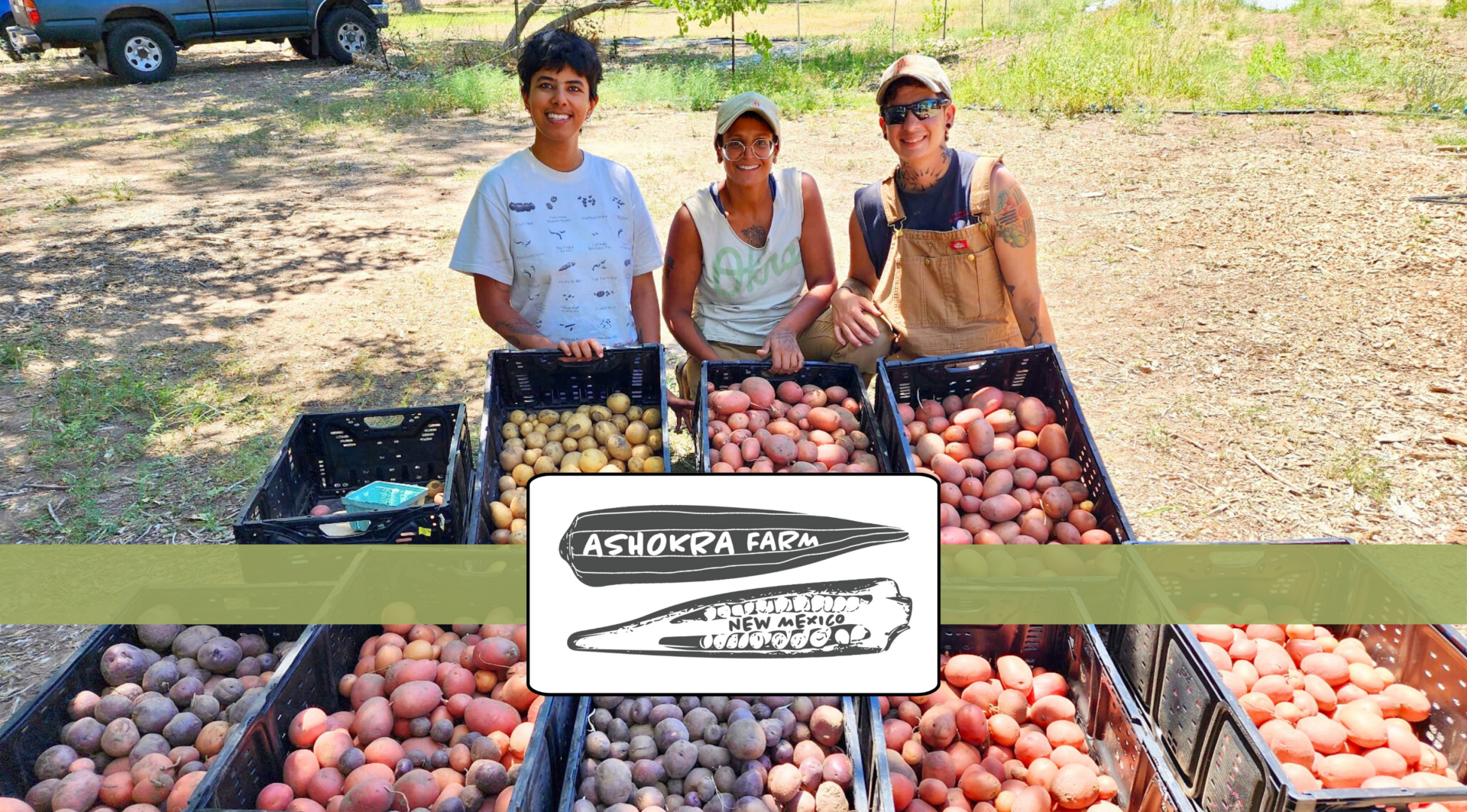
Image: Mallika, Anita and Ash, owners of Ashokra Farm
Anita Adalja has been a farmworker for over 15 years. However, in those 15 years she has also been a social worker, educator, advocate, and community organizer. The culmination of all of these experiences is what led her to found Not Our Farm (NOF), a nonprofit based here in New Mexico, whose work and partnerships span the country. Not Our Farm started at the end of 2019 as an interview project, sharing the stories of fellow non-land or business-owning farmworkers. It has now grown into a nonprofit aimed at increasing visibility around the challenges and abuses that happen on farms, regardless of size, location, or reputation. Not Our Farm is building power among farmworkers by cultivating a community in which farmworkers share their stories and skills, create resources, and form relationships with each other.
 Anita has been drawn back to farming over and over again. “What originally drew me to farming was the camaraderie and sense of belonging among fellow farmers; working the land felt like home.”
While she was meeting passionate individuals like herself who were gaining knowledge and skills in farming, she was also noticing and experiencing a lot of harm happening to herself and other farmworkers working for small-scale farms across the country.
Still today there are few federal protections for farmworkers, and those that are in place vary state to state. Across the country, farmworkers face severe retaliation for organizing and forming unions. There is no cap on working hours or opportunities for overtime pay, and there is no federal oversight or standards for farmworkers working in extreme heat conditions, to name a few challenges.
Anita shared that small farms have even fewer protections because they often aren’t grossing enough revenue to be subject to the Food and Drug Administration’s food safety regulations that require operations to have adequate bathroom access, sick leave, or break areas. The Occupational Safety and Health Administration also often does not cover small farms because it applies only to businesses with ten or more employees, and small farm crews are often smaller than that.
What Anita experienced–and later reaffirmed in her interviews with other small-scale farmworkers– included no access to functional bathrooms or handwashing stations, no break area for people to eat so they’re not eating in the fields (and possibly contaminating crops), lack of safety standards for working in heat or other hazardous conditions, absence of sick leave, and no set end times for workdays.
In even more extreme cases, Anita and most of the farmers she interviewed also reported experiencing sexual harassment, sexism, racism, wage theft, homophobia, and physical disability resulting from farmwork.
After more than a decade of these experiences while working for other farm operations, it became clear that in order to remain in the field, Anita and fellow farm partners–also former farmworkers– Ash and Mallika, would need to start their own farm and set out to try something different in both farming and business.
Welcome to Ashokra Farm, founded in 2020. Ashokra Farm is a small, diversified operation working on three plots in Albuquerque, New Mexico.
Ashokra Farm intentionally does not center profit. Instead, its goal is rooted in community building and safety. In a capitalist system that prioritizes yields, production, and output, Ashokra Farm takes the opposite approach, prioritizing what its owners seek in a farming experience: the ability to show up as their full selves in a workplace that is not abusive or exploitative and that centers people, safety, education and community.
All of the owners of Ashokra farm work other jobs to support themselves. This is also true of 80% of small farmers in New Mexico. Ashokra’s farmers identify as “moonlighters”–evening and weekend farmers–meaning that, after years of experience, they have created a farming practice that allows them to stay connected to the land in an authentic way while having the space to take on work that supports their financial needs.
One of those off-farm jobs includes Anita’s work with the NMFMA for the past seven years. As a food safety trainer and reviewer under the New Mexico Grown Approved Supplier Program, this contract position has allowed her to work with small farms all over the state to improve food safety practices, which she also sees as community care. Providing that education allows those farms to better care for their own communities with practices that keep them, their workers, and their customers safe. Image: Anita during a food safety training.
This month, Not Our Farm is launching a Farmworker Emergency Fund.
To support this fund, Not Our Farm is requesting the purchase of their educational resources, which include guides such as “Farming Into the Future by Centering Farmworkers,” among other helpful zines, posters, and stickers.
Anita acknowledges that the farmworkers Not Our Farm works to uplift often come from more privilege than immigrant workers on a large commodity farm. However, “We’re all victims of this messed up food system, and it’s up to us to be in solidarity and try different ways of working to improve the health and safety of workers.”

Not Our Farm bumper stickers
As one of the Not Our Farms bumper stickers says: “No Farmworkers, No Food.”
In an industry entrenched in human labor, change and new approaches are required to shift toward healthier solutions.
The work of Not Our Farm is making a difference, if even incrementally. After publishing their pamphlet, “Lets Talk About Labor and your Local Produce,” the Downtown Growers’ Market in Albuquerque added new questions to their vendor application specifically asking about farmworkers, how they’re paid, and if the farm is engaged in community work.
The questions put a light on the often invisible farmworker and lets the applying farm know that that is part of the consideration.
This month is National Farmworker Awareness Week, and the NMFMA is pleased to uplift this local resource. Additional efforts are taking place in March, both locally and nationally, to support farmworker rights across the country. Head to the end of the newsletter for more organizations working to uplift farmworker rights and ways you can get involved.
Not Our Farm